This document presents the results of a field survey carried out in September 1993 and funded by the European Commission. The aim was to analyse usage of minority languages in a region of Northern Greece, which resembles a linguistic mosaic. In this region made up of the departments of Florina and Aridea, aside from the dominant Greek language, the following languages are still in use: Macedonian, Valak (close to Romanian), Arvanitika (close to Albanian), Turkish, Rom and the Pontic dialect (a Greek dialect used by previous inhabitants of the Black Sea or Pontos). The team, made up of two Dutch anthropologists, Riki Van Boeschoten and Helleen van der Minne, visited 72 of the 139 villages in the region.
Socio-economic aspects
The current linguistic situation
Factors of preservation and decline
Degree of vitality
This paper presents the main results of a field survey carried out in September 1993 and financed by the European Commission1. The aim of this survey was to analyse the use of minority languages in a region of northern Greece which presents itself as a linguistic mosaic. In this region formed by the counties of Florina and Aridea, in addition to the dominant language (Greek), the following minority languages are still in use: Macedonian, Vlach (close to Romanian), Arvanitika (close to Albanian), Turkish, Roma and the Pontic dialect (a Greek dialect used by the ancient inhabitants of the Black Sea or Pontos). Our team consisted of two Dutch anthropologists, Riki Van Boeschoten and Helleen van der Minne. We visited a total of 72 of the 139 villages in the region.
Our research was designed as a survey integrating linguistic phenomena with all aspects of the socio-economic context. In each village, we contacted the mayor or village secretary and interviewed him or her using a questionnaire. If neither was present in the village, we contacted other villagers. The villagers included in the research represent approximately 65% of the Slavic-speaking group, 90% of the Vlach-speaking group, and 100% of the Arvanitika-speaking group, out of the entire population of the two departments. The distribution of linguistic groups is shown in Tables 1 and 2.
| Table 1 - Rural population of the Florina district / Tableau 1 - Population rurale du département de Florina | |||
| Language group | No. of villages | Inhabitants | % |
|---|---|---|---|
| Slavophones | 43 | 15,228 | 42 |
| Arvanites | 3 | 2,114 | 6 |
| Valaques | 6 | 789 | 2 |
| Réfugiés grecs | 13 | 5,554 | 15 |
| Mixtes | 29 | 12,527 | 35 |
| TOTAL | 94 | 36,212 | 100 |
| Table 2 - Rural population of the Aridea district / Tableau 2 - Population rurale du département d’Aridea | |||
| Language group | No. of villages | Inhabitants | % |
|---|---|---|---|
| Slavophones | 10 | 5,502 | 22 |
| Valaques | 3 | 1,181 | 4 |
| Réfugiés grecs | 15 | 5,515 | 22 |
| Mixtes | 17 | 12,527 | 50 |
| TOTAL | 45 | 24,728 | 100 |
Our results on these three languages are therefore representative of the situation in the region studied. It is more difficult to estimate the representativeness of speakers of the Pontic dialect, since this group cannot be easily distinguished from Greek refugees2 from other parts of Turkey. Nevertheless, we visited 17 villages inhabited by speakers of this dialect, which allowed us to get an idea of the frequency of its use. In some villages, refugees from Asia Minor also speak Turkish (Table 4).
Florina County has always been an underdeveloped agricultural area, partly due to unfavourable natural conditions, and partly for social and historical reasons. The conditions of extreme poverty that marked the region from the Ottoman period to the 1960s are now a thing of the past. However, it is still one of the least developed regions in the country. There is almost no industry: 53% of the working population is employed in the primary sector, while only 20% is employed in the secondary sector and 27% in the tertiary sector (the national percentages are 25%, 27% and 47% respectively3). The DEI power plant is the main employer, but a large part of the workforce is recruited from other parts of Greece. There are also twelve small-scale industries that employ about 500 workers, but most of them are recruited only on short-term precarious contracts. In agriculture, the average holding is three hectares, but many have less and there are a significant number of young landless farmers. The main agricultural products are cereals, tobacco and livestock. Agriculture has been modernised and living standards improved, mainly through EEC subsidies, but the cost of production is high and most farmers are underemployed for a large part of the year. The unemployment rate is among the highest in the country,4 while only a third of the unemployed receive unemployment benefit.5 There are marked differences between language groups in access to public employment, higher education and property. Refugees are the best off, while Slavophones are at the bottom of the social hierarchy, along with Gypsies.
The Aridea region is more prosperous than Florina. Its milder climate and fertile plain allow up to three harvests per year. Agricultural production is largely commercialized: the main crops are tobacco, peaches and cherries. The intensive cultivation practiced in this sector of production partly compensates for the major problem of the region: the lack of land. The average property is only 1.5-2 hectares. Since the 1980s, the standard of living of farmers has improved significantly thanks to EEC subsidies. However, in the last two or three years, the fruit sector has entered into crisis, both because of overproduction and transport problems linked to the Yugoslav crisis. Currently, only 10 to 40% of the fruit production is marketed, the rest being destroyed. The region has experienced significant industrialization, but most factories are small and employment rarely exceeds a few months per year. As in Florina, almost all factories are in the hands of refugees. The unemployment rate among young people who have completed secondary education is high, but lower than in Florina. There is a significant difference between poor and rich villages: the former category includes mainly mountain villages inhabited by Slavic speakers, while rich villages are located in the plain and are mainly inhabited by refugees. 6 However, in this department, socio-economic distinctions between language groups are less clear than in Florina.
Greek is undoubtedly the dominant language throughout the region, and the number of people who do not speak it at all can be counted on the fingers of two hands. This is due to the factors of decline discussed below, as well as the total absence of measures in favour of minority languages. It must be stressed, however, that despite this unfavourable context, they have shown great vitality. The degree of preservation is higher in relatively poor and isolated villages, but minority languages are also well represented in some of the most dynamic villages. In the latter, the minority language even tends to be the dominant language in interpersonal communication.
A more surprising fact concerns the attitude of the local population towards minority languages. The Greek authorities are very sensitive to the issue of minority languages, because, in their opinion, recognition of these languages would open the door to territorial claims by neighbouring states. However, although this official view is reflected in local discourse, especially through the media, the existence and use of minority languages is generally accepted as a reality independent of its possible political implications. Another contradiction: people with a certain level of education tend to regard the use of minority languages as a sign of “backwardness”, but many speakers of such languages are proud of their cultural heritage, especially their language. We found that these feelings of pride are manifested especially among Vlachs and Pontic Greeks. It probably also exists among many Slavic speakers, but the latter are reluctant to express such feelings publicly.
A third general observation concerns the use of minority languages by age group. As a rule, people over sixty years of age speak the minority language fluently as their first language. The average age group, between thirty and sixty, is bilingual, and, depending on their situation in the different villages, speaks Greek or the minority language as their first language. In the family, parents often speak the minority language among themselves, but use Greek to address their children, so that the latter can learn Greek properly and improve their chances on the labour market. Grandparents often speak the minority language to their grandchildren. Many adolescents have a good knowledge of it, but when they attend mixed schools in urban areas or when they leave their village to work elsewhere, they tend to lose it. Primary school children generally understand the minority language, but do not speak it. Finally, a note on the gender difference: until the previous generation, women were the main vectors of family traditions, including language. In particular, grandmothers played a crucial role in the transmission of the language.7 This seems to be changing today: in many households, women more than men are keen to speak Greek to their children.
As with most linguistic minorities, the influence of national institutions dominated by the national language is a major factor in the decline of minority languages. These institutions include the education system, the military and the media. The abandonment of minority languages is also linked to mixed marriages, although in this region marriages between language groups are a relatively recent and limited phenomenon. The effects of this situation are multiplied by a number of factors specific to the region, often linked to the language policy of national and regional authorities. The memory of past linguistic repression (especially under the regime of Ioannis Metaxas, 1936-1940, and during the civil war), as well as current discouragement, have created a climate of fear regarding the use of minority languages. This psychological dimension is more pronounced among older generations of Slavic speakers, while it does not seem to affect speakers of the Pontic dialect. Another element that plays an important role among the Slavophone group has been the establishment, since the 1950s, of daycare centers and kindergartens in most Slavophone villages, so that children learn Greek at an early age. The current generation of Slavophone mothers has attended such schools, which could explain why the role of women in language transmission is less important today than in the past. Finally, the role of emigration should be mentioned. Typically, those who emigrated to Western Europe integrated into a community of Greek speakers in the host country, and not into a group of speakers of the minority language. Since many of these emigrants have returned to Greece or visit their village regularly during the holidays, their linguistic behavior has a certain influence at the local level.
However, several phenomena have contributed to the preservation of minority languages. First of all, the relative isolation of the rural population, the limited extent of industrialization and the low degree of urbanization (except for the refugee group) should be mentioned. These factors prevent the creation of a "melting pot" effect. A second element is the existence of marked inter-ethnic divisions in the socio-economic sphere and the low degree of marriage between these groups. Third, the vitality of folk traditions, in which the minority language often plays an important role (especially for Slavic speakers and Pontic refugees). In addition to these internal factors, there are also a number of external influences that favor the preservation of minority languages. Let us first mention the role of foreign media offering programs in the same or similar languages to the minority languages spoken in the region. The programs that can be captured in the region are those of the radio and television of Skopje and Tirana, and of the radio of Sofia. These programmes are often recorded on cassette or videotape and then passed from one family to another. Another important element is the contacts with relatives living abroad in a country where the minority language is dominant and who often do not understand Greek, since they left their native village when the use of Greek was much more limited. The latter factor mainly concerns former political refugees, who fled the region after the civil war (1946-1949) and many of whom are Slavic speakers. Finally, one should mention the presence of new immigrants and "purchasing visits" by foreigners from countries where minority languages are dominant, i.e. from the former Yugoslavia and Albania. The influence of these preservation factors is strongest for Macedonian.
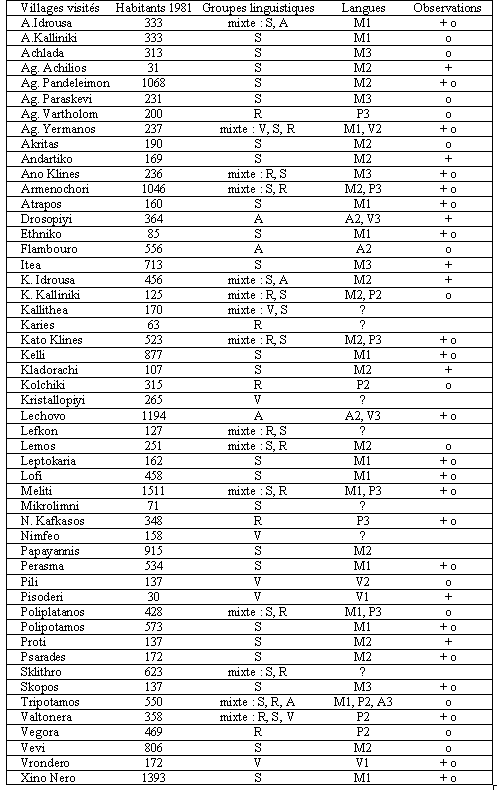
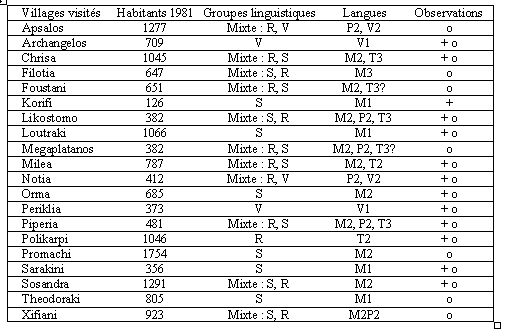
We classified the villages into three categories, according to the degree of vitality of the minority languages (Tables 3 and 4):
– in group 1, the level of preservation is the highest. The minority language is the usual language of communication, along with Greek, in public and in private. It can even be used by the communal authorities in their transactions with the villagers;
– in group 2, the percentage of people who have learned the minority language as their first language is lower than in group 1. Most people over thirty have learned both languages at the same time and are bilingual, but people over fifty or sixty feel more comfortable in the minority language. It is still often used in everyday life, but more in private than in public. As a rule, people under twenty do not speak the language, but have a good level of understanding;
– in group 3, the minority language is spoken only by older people and in the majority of cases only in private.
In the towns of Florina and Aridea one can hear the whole range of minority languages, especially during market days, when farmers from the villages come down to the town to sell their products. The usual language of communication is obviously Greek, since the urban population is largely mixed. These two towns are also the place of residence of the Gypsies, who speak, apart from their own language (Roma), all the other languages used in the region.
| Département | Villages visités | Habitants 1981 | Langues | Macedonian District * | Macedonian Village Name * |
|---|---|---|---|---|---|
| Florina | A. Idzousa | 333 | M1 | Lerinsko | Lerinsko |
| Florina | A. Kalliniki | 333 | M1 | Lerinsko | Lerinsko |
| Florina | Achlada | 313 | M3 | Lerinsko | Lerinsko |
| Florina | Ag. Achilios | 31 | M2 | Lerinsko | Lerinsko |
| Florina | Ag. Pandeleimon | 1,068 | M2 | Lerinsko | Lerinsko |
| Florina | Ag. Paraskevi | 231 | M3 | Lerinsko | Lerinsko |
| Florina | Ag. Vartholom | 200 | P3 | Lerinsko | Lerinsko |
| Florina | Ag. Yermanos | 237 | M1, V2 | Lerinsko | Lerinsko |
| Florina | Akritas | 190 | M2 | Lerinsko | Lerinsko |
| Florina | Andartiko | 169 | M2 | Lerinsko | Lerinsko |
| Florina | Ano Klines | 236 | M3 | Lerinsko | Lerinsko |
| Florina | Armenochori | 1,046 | M2, P3 | Lerinsko | Lerinsko |
| Florina | Atrapos | 160 | M1 | Lerinsko | Lerinsko |
| Florina | Drosopiyi | 364 | A2, V3 | Lerinsko | Lerinsko |
| Florina | Ethniko | 85 | M1 | Lerinsko | Lerinsko |
| Florina | Flambouro | 556 | A2, V3 | Lerinsko | Lerinsko |
| Florina | Itea | 713 | M3 | Lerinsko | Lerinsko |
| Florina | K. Idrousa | 456 | M2 | Lerinsko | Lerinsko |
| Florina | Kato Kalliniki | 125 | M2, P2 | Lerinsko | Lerinsko |
| Florina | Kallithea | 170 | ? | Lerinsko | Lerinsko |
| Florina | Karies | 63 | ? | Lerinsko | Lerinsko |
| Florina | Kato Klines | 523 | M2, P3 | Lerinsko | Lerinsko |
| Florina | Kelli | 877 | M1 | Lerinsko | Lerinsko |
| Florina | Kladorachi | 107 | M2 | Lerinsko | Lerinsko |
| Florina | Kolchiki | 315 | P2 | Lerinsko | Lerinsko |
| Florina | Kristallopiyi | 265 | ? | Lerinsko | Lerinsko |
| Florina | Lechov | 1,194 | A2, V3 | Lerinsko | Lerinsko |
| Florina | Lefkon | 127 | ? | Lerinsko | Lerinsko |
| Florina | Lemos | 251 | M2 | Lerinsko | Lerinsko |
| Florina | Leptokaria | 162 | M1 | Lerinsko | Lerinsko |
| Florina | Lofi | 458 | M1 | Lerinsko | Lerinsko |
| Florina | Meliti | 1,511 | M1, P3 | Lerinsko | Lerinsko |
| Florina | Mikrolimni | 71 | ? | Lerinsko | Lerinsko |
| Florina | N. Kafkasos | 348 | P3 | Lerinsko | Lerinsko |
| Florina | Nimfeo | 158 | ? | Lerinsko | Lerinsko |
| Florina | Papayannis | 915 | M2 | Lerinsko | Lerinsko |
| Florina | Perasma | 534 | M1 | Lerinsko | Lerinsko |
| Florina | Pili | 137 | V2 | Lerinsko | Lerinsko |
| Florina | Pisoderi | 30 | V1 | Lerinsko | Lerinsko |
| Florina | Poliplatanos | 428 | M1, P3 | Lerinsko | Lerinsko |
| Florina | Polipotamos | 573 | M1 | Lerinsko | Lerinsko |
| Florina | Proti | 137 | M2 | Lerinsko | Lerinsko |
| Florina | Psarades | 172 | M2 | Lerinsko | Lerinsko |
| Florina | Sklithero | 623 | ? | Lerinsko | Lerinsko |
| Florina | Skopos | 137 | M3 | Lerinsko | Lerinsko |
| Florina | Tripotamos | 550 | M1, P2, A3 | Lerinsko | Lerinsko |
| Florina | Valtonera | 358 | P2 | Lerinsko | Lerinsko |
| Florina | Vegora | 469 | P2 | Lerinsko | Lerinsko |
| Florina | Vevi | 806 | M2 | Lerinsko | Lerinsko |
| Florina | Vrondero | 172 | V1 | Lerinsko | Lerinsko |
| Florina | Xino Nero | 1,393 | M1 | Lerinsko | |
| Aridea | Apsalos | 1,277 | P2, V2 | ||
| Aridea | Archangelos | 709 | V1 | ||
| Aridea | Chrisa | 1,045 | M2, T3 | ||
| Aridea | Filotia | 647 | M3 | ||
| Aridea | Foustani | 651 | M2, T3? | ||
| Aridea | Korifi | 126 | M1 | ||
| Aridea | Likostomo | 382 | M2, P2, T3 | ||
| Aridea | Loutraki | 1,066 | M1 | ||
| Aridea | Megaplatanos | 382 | M2, P2, T3? | ||
| Aridea | Milea | 787 | M2, T2 | ||
| Aridea | Notia | 412 | P2, V2 | ||
| Aridea | Orma | 685 | M2 | ||
| Aridea | Periklia | 373 | V1 | ||
| Aridea | Piperia | 481 | M2, P2, T3 | ||
| Aridea | Polikarpi | 1,046 | T2 | ||
| Aridea | Promachi | 1,754 | m2 | ||
| Aridea | Sarakini | 356 | M1 | ||
| Aridea | Sosandra | 1,291 | M2 | ||
| Aridea | Theodoraki | 805 | M1 | ||
| Aridea | Xifiani | 923 | M2P2 |
This document presents the results of a field survey carried out in September 1993 and funded by the European Commission. The aim was to analyse usage of minority languages in a region of Northern Greece, which resembles a linguistic mosaic. In this region made up of the departments of Florina and Aridea, aside from the dominant Greek language, the following languages are still in use: Macedonian, Valak (close to Romanian), Arvanitika (close to Albanian), Turkish, Rom and the Pontic dialect (a Greek dialect used by previous inhabitants of the Black Sea or Pontos). The team, made up of two Dutch anthropologists, Riki Van Boeschoten and Helleen van der Minne, visited 72 of the 139 villages in the region.
This paper presents the main results of a field survey carried out in September 1993 and financed by the European Commission1. The aim of the survey was to analyse the use of minority languages in a region of northern Greece that presents itself as a linguistic mosaic. In this region formed by the counties of Florina and Aridea, in addition to the dominant language (Greek), the following minority languages are still in use: Macedonian, Vlach (close to Romanian), Arvanitika (close to Albanian), Turkish, Roma and the Pontic dialect (a Greek dialect used by the former inhabitants of the Black Sea or Pontos). Our team consisted of two Dutch anthropologists, Riki Van Boeschoten and Helleen van der Minne. We visited a total of 72 of the 139 villages in the region.
Our research was designed as a survey integrating linguistic phenomena with all aspects of the socio-economic context. In each village, we contacted the mayor or village secretary and interviewed him or her using a questionnaire. If neither was present in the village, we contacted other villagers. The villagers included in the research represent approximately 65% of the Slavic-speaking group, 90% of the Vlach-speaking group, and 100% of the Arvanitika-speaking group, out of the entire population of the two departments. The distribution of linguistic groups is shown in Tables 1 and 2
Florina County has always been an underdeveloped agricultural area, partly due to unfavourable natural conditions, and partly for social and historical reasons. The conditions of extreme poverty that marked the region from the Ottoman period to the 1960s are now a thing of the past. However, it is still one of the least developed regions in the country. There is almost no industry: 53% of the working population is employed in the primary sector, while only 20% is employed in the secondary sector and 27% in the tertiary sector (the national percentages are 25%, 27% and 47% respectively3). The DEI power plant is the main employer, but a large part of the workforce is recruited from other parts of Greece. There are also twelve small-scale industries that employ about 500 workers, but most of them are recruited only on short-term precarious contracts. In agriculture, the average holding is three hectares, but many have less and there are a significant number of young landless farmers. The main agricultural products are cereals, tobacco and livestock. Agriculture has been modernised and living standards improved, mainly through EEC subsidies, but the cost of production is high and most farmers are underemployed for a large part of the year. The unemployment rate is among the highest in the country,4 while only a third of the unemployed receive unemployment benefit.5 There are marked differences between language groups in access to public employment, higher education and property. Refugees are the best off, while Slavophones are at the bottom of the social hierarchy, along with Gypsies.