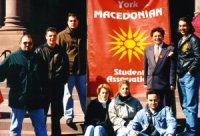
It is difficult to determine the exact size of the Macedonian population in Ontario because most Macedonians travel to Canada on Greek or Yugoslav passports. Unofficial estimates put the Macedonian population at close to 80,000.
Immigration to Ontario from Macedonia began at the end of the 19th century and could best be described in its early years by the Macedonian word "pechalba" meaning temporary emigration from one's village in pursuit of a job. The first Macedonian immigrants were few in number and were all men. They came to work as laborers intending to earn as much money as possible and return to their villages in Macedonian to buy land and raise their standard of living.
Conditions in Macedonia at this time were conductive to emigration. There was a severe shortage of land made worse by inheritance laws which enforced the subdivision of small farms for each successive generation. Heavy taxation and tithes placed an additional burden on the poor villagers. Political difficulties arose after the failure of the Ilinden Uprising of 1903 when the Macedonians revolted against their Turkish rulers, and this gave impetus to emigration. At the same time, around the turn of the century, Canada was in need of workers for its expanding iron and steel foundries, sheet metal industries, railways and slaughterhouses.
In 1910, there were 1,090 Macedonians in Toronto alone. Most of them were bachelors, or married men with families still in Macedonia, and they lived in boarding houses near railways or construction sites. Almost all of them had come from small villages in the regions of Kostur and Lerin in southwest Macedonia near the Albanian border. The difficulties they faced were many - loneliness, inability to speak or understand English, a cold climate and the move from a rural to an urban setting. To help overcome these problems, the Macedonian immigrants lived in the same areas in the city as their fellow villagers and formed associations with them. In 1907, the Oshchima Benefit Society of St. Nicholas was formed by immigrants from the village of Oshchima. In 1910 the Saints Cyril and Methody Macedonian-Bulgarian Orthodox Church was formed in Toronto. It was organized according to the 31 villages in Macedonia from which the people had come. Each elected their own delegates through whom they gave donations for the building of the church and through whom the church was governed. It quickly became the social as well as religious centre of the community.
After 1912, the pattern of immigration from Macedonia changed. In 1913 Macedonia was split into three parts, which were attached to Serbia, Bulgaria and Greece, each of which made efforts to assimilate the Macedonians within its borders. The Macedonian language and religion were forbidden and jobs open to Macedonians were restricted to low-status occupations. As a result, more than 6,000 Macedonians came to Ontario from Greece, although a great many were classified as Greeks when they arrived in Canada. Those who had come earlier as migrants gave up hope of returning and brought their families over to settle down here. Using the money they had saved, they set up small businesses, shops, restaurants, and bakeries often run by the entire family. Macedonian-owned shops were visible in Toronto even before 1930.
After 1945 because of the civil war in Greece, many more Macedonians came to Ontario, usually sponsored by a relative. They would often work as dishwashers, short-order cooks or bakers in the businesses of family members or fellow villagers, and after some time open restaurants or shops of their own.
In the 1960's, and the 1970's most Macedonians emigrating to Ontario tend to come from urban centres and to be well-educated. They have been assimilated into the Greek culture and many do not think of themselves as Macedonian.
There are four Macedonian churches in Toronto under various Eastern Orthodox synods -- Saints Cyril and Methody established in 1910, St. George's established in 1941, St Clement's of Ohrid established in 1962, Holy Trinity established in 1972 and St. Naum, a fifth church, is currently being organized in Mississauga. Many Macedonians attend Greek Orthodox churches.
There are still many social clubs based on village associations as well as various football and hockey teams. Preparations are being made for a bimonthly publication to be printed in Toronto and circulated to the Macedonian communities across Canada. Twice a week there are both radio and television programs in the Macedonian language.
There are many thriving businesses owned by Macedonians in Ontario. It is estimated that Macedonians own two-thirds of the restaurants in Toronto, as well as some doughnut factories, hotels and individual shops. The second generation Macedonians are making contributions in the universities, legal establishments, sports fields, and medical professions. A chair in Macedonian studies is now being established at the University of Toronto.