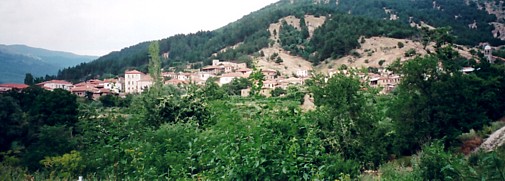
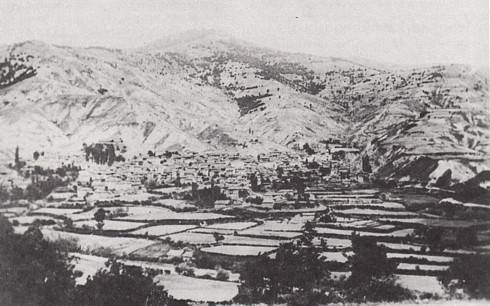

The Zhelevo Village, district of Kostur, Macedonia, was one of the comparitvely larege villages in the district of Kostur. It was the second largest after Smurdesh Village in Koreshtata. Zhelevo is nestled in and surrounded by mountains and it lies at the foot of Mt. Bigla. It is pretty and a picturesque village. The river Bistritsa takes its source from the mountains near the village and empties into the Gulf of Solun (Salonica). It lies on the highway connecting the cities of Kostur and Lerin.
Prior to 1912 the village counted approximately 270 houses. There were two public schools in the village, one junior high school and two churches - St. Nicholas and St. Atanas. On its north-east boundary is the village Pisoderi and on the northern boundary, the village German; to the north-west the village Rudari and Paply; to the west Oronik and Bukovik; and to the south-east the villages Oshchima and Tersia.
THE FOUNDING OF THE VILLAGE
It is not exactly known who were the first settlers of Zhelevo the village, as it stands today, is divided into two : the Old Zhelevo and the New Zhelevo. There is no concrete historical information to tell us who were the first settlers of the village. Of course, as it is in other villages, there are legends connected with Zhelevo which tell us about the first settlers of the village.
One of these legends, which I consider most plausable, states as follows : After an unsuccessful uprising against the Turks, six or seven families living in the plain ran away and settled in the location called "Old Zhelevo" where there was a dense and impenetrable forest. This location was practically inaccessible to the Turks and therefore considered safe by the settlers. The Turks would have never dared attempted to enter such places. There was actually no need for them to go to such places because they were mostly interested in the plains, where people lived, and not in the mountainous locations. Thus the settlement of Zhelevo began. But who were the settlers and where they came from is unknown to us. Even the year in which this event took place is unknown, nor it is known in what year the uprising against the Turks took place. This legend I consider to be true because the majority of the villages in the Macedonian mountain regions came into existence this way. Revolts and uprising took place and the besieged "raya" (enslaved population) had to leave their homes, run from the Turks and hide in save places which were in the mountains.
The eminent Belgian scholar and politician Augier Bousbec, who travelled though the Balkans in 1553 as an ambassador of the Emperor Ferdinand I, tells us of additional reasons why the Christians were abandoning their houses and their fertile land, and were running away to impenetrable locations. He writes thus : "Often, the Christians were annoyed by the tiresome proudness and insolence of the Turks, and withdrew from the "king's road" and went to places which were inaccessible and safe, leaving behind better land to the powerful Turks."
It is for such reasons that the population was forced to leave everything behind and search for safer locations in which to hide from the persecutions of the enslaver, and to start a better life. Many of the settlements in Macedonia, and in other parts of the Balkan Peninsula, came into existence because of the persecution of the Turks.
It is not exactly known how long the settlers lived at the first location - "Old Zhelevo", but in all probability it can be accepted that they lived there for many years. So the legend states. What forced the residents of "Old Zhelevo" to leave this place and relocated in New Zhelevo? Old people have told us that they have heard through traditions : that it had happened after a torrential rain. It is said that the rains were so heavy and terrifying, that it swept away the houses, the animals, the gardens and the fields of the people of Old Zhelevo. This forced them to settle on the new location - the present Zhelevo. The foundations of the houses of Old Zhelevo still existed before 1915.
Another legend tells us that a special ceremony was performed by the villagers before they settled in the new location. The people believed that by doing this ceremony, the new settlement would escape destruction, be it by men or natural calamity. The ceremony was as follows : at the suggestion of some of the older people, two heifer-twins were harnessed and, with the help a furrow was made tracing the boundaries of the new village. Two young boys who were twins led the heifers. It seems that this superstitious belief worked out for Zhelevo. Many of the nearby villages were either burnt or destroyed during the uprising or by the calamity of nature, but Zhelevo remains intact to this day. Zhelevo was not affected by the Ilinden Uprising, nor by the Balkan War, nor suffered damages during the First and Second World Wars.
At first the settlers earned their livelihood as wood-choppers. They cut trees from the dense forest and transported them for sale to the small town of Lerin. At the same time they began woodcarving; they made wooden bowls, spoons and boxes. Some of them took advantage of the favourable surrounding which contained ample wild game, and began hunting. Others made ploughs, yokes, cart wheels, carriages, etc., which they sold to the villagers in the neighbourhood. Later on, they began to cultivate the land. Land was scarce and was need for the grazing of livestock.