The majority of the inhabitants of Macedonia are Slavs and adherents to the Eastern Orthodox faith. They accepted Christianity in the IXth century from the disciples of Cyril and Methody, two monks from Thessaloniki who created the Slavic alphabet.
The customs described are typical of villages in Southern Macedonia as remembered by our parents and grandparents who emigrated to Canada between 1895 and 1950 (nearly all of Toronto's Macedonian community up to 1950 was from the southern part of Macedonia which has belonged to Greece since 1912). The life that they led was a simple agricultural life with the keeping of large flocks of sheep and goats in the mountain villages. The people were poor in material things and the area ravaged by many wars and oppression.
Religious holidays are celebrated by most Eastern Orthodox churches by the Julian calendar which is 13 days behind the Gregorian calendar. The date for the celebration of Easter is based on a rule set by the Council of Nicaea in 325 A.D. Easter would always fall on the Sunday following the Paschal (Jewish Passover) full moon which is the first full full moon of the vernal equinox. When Passover and the full moon fall on a Sunday, Orthodox Easter is celebrated a week later since Christ's "last supper" was the celebration of Passover.
Easter, which is the greatest holiday in the Eastern Orthodox Church is preceded by a lenten period of seven weeks during which no food of animal original may be eaten (oil also, was not eaten since it was stored in animal skits). During the week before the lenten period, everyone abstains from meat only - this is called SIRNATA NEDELA (cheese fare week).
The Sunday before lent starts (Zapostvanie) is the day of forgiveness (Proschavnie). On this day, after Church the younger people visit the older people in their families in turn and kiss their hand and ask to be forgiven for any wrongs they may have done so that they can start lent with a clear conscience. Each house has many rich and sweet foods like baklava, kadaif, zelnik, maznik, halvah, and boiled eggs (foods which may not be eaten during lent) for the many visitors. The main meal no this day is fish.
In the evening, the old custom of "amkanieh" is observed. An older person in the family, usually a woman, ties a boiled egg by a string to a rolling pin (long dowel) or distaff. She swings the egg to each person in turn who tries to catch it with their mouth. This is a fun time before the seriousness of lent. After this, the string is lit for each person (and put out) to see how bright a flame there is for each one. The brighter the flame the stronger the person.
The following day, the first of Lent, some people observe "TRIMIR". They do not eat or drink anything for two full days and nights and on the third morning (Wednesday) they go to a special church service where they are given NAYAZMO (Holy Water) to drink. They take lenten foods with them like OSHAF, a mixture of boiled raisins, figs and prunes or boiled wheat with crushed hemp seed in it. After the service all of these people share the food they have brought with each other in the church.
During lent, fish may be eaten on two days; the Annunciation of the Virgin Mary (March 25) and the Feast of the Resurrection of Lazarus (the Saturday before Palm Sunday).
Lazaruvane is a custom celebrated on St. Lazarus day (on the Saturday immediately preceding Palm Sunday). This was also a pre-Christian custom, namely the celebration of the coming of Spring. The most beautiful girl was chosen to be called "Lazarka". She was dressed in her most beautiful dress, flowers in her hair and very elaborate jewelry. The young Lazarki went from house to house singing appropriate songs for every member of the family. In their songs and dances they wish happiness, health, long life and fertility. There are also songs blessing the fields, the woods and the rivers. The young Lazarki bless the whole world in their happy songs. Before departing from each house the Lazarka would kiss the hand of the hostess and collect gifts. Among the gifts received there would always be eggs and flour.
On Palm Sunday (TSVETNITSA or VRBNITSA) the people who attend church are given either small wild flowers (lazarsko tsveke) or willow branches or the leaves of small evergreen plant (zelenika).
In the week before Easter, the shepherds take their lambs to the town to sell (village people usually have their own) and the lamb is kept alive all week in their yards.
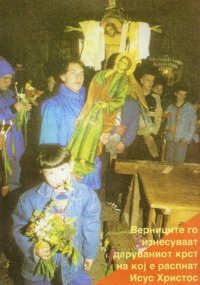
There is a church service every night in the week before Easter. On the Thursday before Easter, all the women dye their boiled Easter eggs red to signify the blood of Christ. In the morning church service all of the parishioners are marked with a cross of holy oil on their forehead. In the evening there is a reading of the twelve gospels telling the story leading to the crucifixion of Christ. At the beginning of the reading of each gospel the church bell is rung - the number of times corresponds to the number of the gospel. The cross with the crucified Chirst is brought out and placed in front of the congregation who venerate it - some putting gifts of towels on it (to be used in the church).
On Good Friday a bier is set up and the icon of the dead Christ which is painted on a large cloth (PLASHTENITSA) is set on the bier. The people go to the church all day and take flowers, and in older times, gifts of socks, scarves, towels and clothing to place on the bier (the clothing is sold at a later date to raise money for the church). Children pass under the plashtenitsa in the bier for "good health".
In the evening a sombre service is held and the whole congregation, holding candles, sings a long lament (VSICHKETE RODOVI) telling how Christ suffered. The people go to the bier one by one to venerate the dead Christ and the flowers from the bier are given out to them by the priest. The "plashtenitsa" is raised over the heads of four men and carried out in procession around the church with all the parishioners holding their lit candles following.
The plashtenitsa is taken back into the church and held over the doorway and each person passes under it as they re-enter the church. It is then folded and placed inside the alter.
On the Saturday the women bake their Easter bread which, in some areas is made with fermented chick peas instead of yeast (lep so maya). Others make a sweet rich egg bread (some bake on the Thursday or Friday). The lamb is killed and a soup prepared from parts of it (stomach and intestines are a delicacy) to be eaten after the midnight service.
At night around 11:00pm everyone goes to church (each with a red Easter egg and a candle). The church is in darkness and at midnight the priest emerges from the iconostasis with lit candles and proclaims that "Christ has Risen" and the people answer "Truly He Has Risen". Each person lights their candles from the person in front of them (all from the candles of the priest)> The person offering the light says "Christ has Risen" and the person lighting their candle answers "Truly He Has Risen".
The icon the of Risen Christ is carried outside the church and a short service is held in front of the church where everyone, holding their lit candles, crack eggs with their friends (and eat them - lent being over). A procession is made around the church and everyone enters for a service until 3:00am. They then go home and have their lamb soup.
The next day the lamb is roasted on a spit and everyone goes to church dressed in new clothes for a short service where the priest gives everyone a red Easter egg. Outside the church they exchange Easter eggs with all their friends and relatives. Everyone "cracks" eggs and the person whose egg "survives " without breaking is supposed to have good luck. This egg is put by the family icon at home and buried in the vineyard the next February on St. Trifon's Day. They then have their lamb dinner. There is a big dance in the middle of the village where all the people dressed in their new clothes go to celebrate. The celebration lasts three days. On Easter Monday married girls visit their parents with their own families.
On Easter Tuesday there is a short church service in the morning and then a dance in the centre of the village. Since dating was not allowed, this is where the young men got to see the girls and pick a prospective bride.